Manafall
A downloadable game
A procedural island
The world is built in streaming chunks from layered noise, erosion, and island falloff — producing a single large landmass surrounded by open ocean. Eight biomes emerge from height, moisture, temperature, and slope: ocean and beach, grassland and forest, desert, mountain, snow, and tundra. Climate varies by region; cold biomes and frigid nights can drain your warmth if you are not prepared.
Living sky and sea
A full day/night cycle drives sun, moon, ambient light, and moon phases — some of which matter for rituals and transformations. Weather moves through clear skies, cloud cover, fog, light and heavy rain, and storms, affecting visibility, atmosphere, ocean swell, and what you can safely do outdoors. The sea uses realistic wave simulation; boats respond to hydrodynamics, and fish bobbers ride the swell.
Exploration and discovery
Chart the island on a fog-of-war map as you travel. Ruins and monuments register as landmarks. Snow records your footsteps. You can swim and dive with an oxygen system, explore coastlines, and fish from shore or open water. A compass, ladders, mounts, and boats extend how far you can go — from horses and donkeys to sailboats and even a flying carpet.
Survival
Core needs press on you constantly:
- Hunger — drains with movement and exertion; starvation damages health over time
- Thirst — must be refilled from wells, water sources, and carried supplies
- Stamina — limits sprinting and swimming
- Cold — biome and night exposure; armor and warmth sources help
- Health — combat, falls, environmental hazards, and status effects
Sleep and respawn tie into beds, tavern lodging, and world-registered sleeping spots. Death drops loot; recovery depends on what you secured beforehand.
Two supernatural transformations can infect your character — vampirism and lycanthropy — each with its own hunger, weaknesses (such as sunlight for vampires), combat modes, and alchemical cures. They are mutually exclusive paths, not cosmetic choices.
Practice Skills
There are no arbitrary skill trees. You level skills by using them — up to level 100 across 31 practice skills, tracked per player and synced on the server.
Swing a sword and Blades rises. Land blows with a mace and Blunt improves. Draw a bow and Archery tightens. Cast from a grimoire and Spellcraft and Elementalism grow. Brew beer, mix potions, chop wood, mine ore, fish, pick locks, place building pieces, tend crops, trade at market — each action feeds the skill it belongs to. Sprint and jump build Athletics. Swim underwater and Swimming and Breath advance. Take hits and Fortitude hardens. Sneak past guards and Stealth grows.
The full skill set spans combat (Blades, Blunt, Archery, Blocking, Throwing), magic (Spellcraft, Elementalism, Warding, Enchantment), crafting and gathering (Blacksmith, Alchemy, Brewing, Cooking, Woodcutting, Mining, Fishing, Foraging), survival (Athletics, Breath, Swimming, Endurance, Fortitude, Survival, Medicine), and life on the island (Stealth, Lockpicking, Building, Farming, Sailing, Taming, Trading).
Higher levels grant real bonuses tied to that activity: tighter bow spread, better spell cast reliability, cheaper enchantment research, improved lockpick windows, stronger alchemy yields, faster swimming, reduced stamina drain, better trading prices, and more. Gear and potions still matter — practice makes you more proficient, not invincible.
Each level-up also grants soul points, tying long-term character growth into enchantment, summoning, and other arcane systems. Your skill sheet lives in the inventory UI so you can see each level and progress toward the next rank.
The island teaches you back. A blacksmith is someone who forged. A fisher is someone who cast. A mage is someone who survived their own mistakes.
Civilization on the Edge
Villages still cling to the island. Civilians are not static shopkeepers — each one runs on a full day/night schedule tied to the world clock, sunrise and sunset, weekdays vs. weekends, and their job.
Player Towns — Claim, Join, and Build Together
Not every settlement is NPC-only. Players can found and run towns using a Warden Core — a claim object that defines a territory (roughly 40+ meters radius) where building rules apply.
Owning a town
Place a Warden Core to become town owner. You control:
- Who can build inside the claim
- Daily taxes — set which items residents owe per 24-hour cycle
- Build permits — approve or batch-grant requests from residents
- Core level (1–5) and decay upkeep — the town needs daily maintenance or the core decays and building inside the claim shuts down
- Auto-kick — optionally remove residents who fall too far behind on tax debt
The owner can build freely. Everyone else needs permission.
Joining a town
Walk up to a Warden Core and apply to join. The owner reviews applicants and approves residents. Once accepted:
- You can build inside the claim when you have build permits
- Without a permit, your build request goes to the owner for approval
- You pay daily town tax in whatever items the owner configured
- Fall behind on tax and debt accumulates — owners can auto-kick chronic debtors
This is how groups of players settle together: one person claims land, others join as residents, and the town grows under shared rules instead of free-for-all building.
Daily rhythms
NPC days are built from real time windows, not scripted loops:
- Morning — grace after sunrise, then commute to work
- Work hours — job-specific routines through the daylight window
- Lunch — a midday break (farmers eat, others shop or drink at the tavern; barkeeps keep serving)
- Evening wind-down — activity tapers before sunset
- Night — sleep routines, tavern service where appropriate, and different social behavior after dark
Each profession has its own pattern. Farmers split time between fields and market stalls, with weekend leisure. Blacksmiths alternate forge sessions and breaks across the workday. Merchants and barkeeps keep broader serving hours. Guards patrol on their own shifts. On weekends, most villagers step back from weekday work for shopping, drinking, exploring, or rest.
They navigate doors, stairs, and village paths to reach work posts, beds, taverns, and each other.
Relationships
Every villager maintains persistent bonds — with other NPCs and with you — tracked as affinity and familiarity and expressed through tiers:
Nemesis → Rival → Strained → Neutral → Friendly → Close
Between villagers: Personality shapes who they seek out or avoid. Affinity steers conversation topics — warm bonds open gossip and compliments; strained ones turn toward arguments; shy villagers may refuse sensitive subjects unless trust is high enough. Close friends socialize more; rivals and nemeses keep their distance or clash.
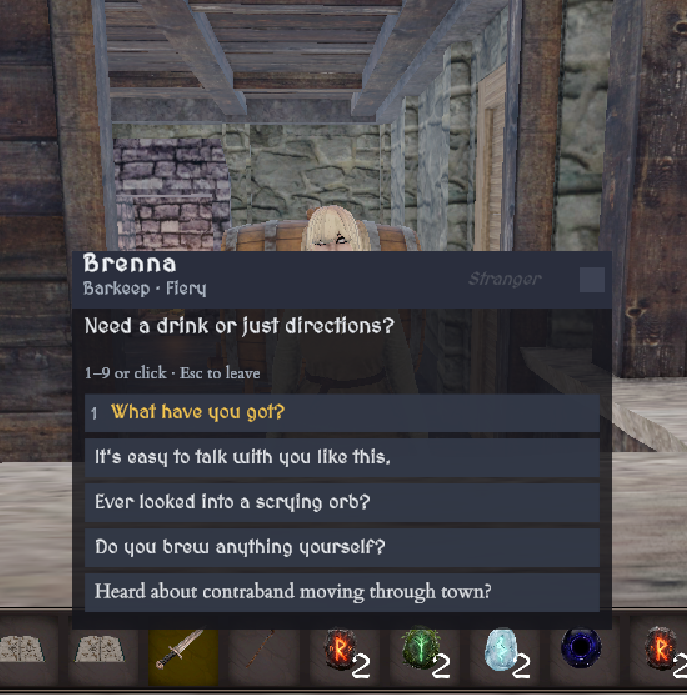
With you: Your standing is tracked separately on a player relationship board, from stranger to close friend, with real gameplay effects. Dialogue shifts with your bond — friendly NPCs are warmer; rivals and nemeses are hostile or curt. Topics succeed or fail based on relationship and personality (romance, rumors, arguments, compliments). Actions have consequences — theft, trespass, and guard run-ins can crash affinity fast. Services respond to trust — tavern lodging, shop tone, and whether someone will talk to you at all.
These relationships are persistent per server and change through how people speak and act, not a one-off reputation score.
Village life
- Taverns — eat, drink, rent a bed for the night, and hear local gossip
- Markets — buy and sell with dynamic pricing; some goods are illegal and draw guard attention
- Blacksmith workshops — copper and steel weapons, leather tanning, staff forging
- Farming — till plots, plant seeds, water crops, harvest produce integrated with village farms
- Law and order — guards fine thieves, confiscate stolen goods, and can imprison players who cannot pay
A roaming Orian trader also circuits the island with a led donkey, rest stops, and a rotating stock — another thread in the island’s economy.
Crafting, Industry, and Magic
Manafall is built around deep, station-based production rather than a single crafting menu.
Gathering and basics
Chop harvestable trees for wood. Mine ore and smelt it in a refinery with fuel management and temperature bands. Cook raw food on stone ovens and fireplaces. Process hides on racks. Draw water from wells.
Blacksmithing and tools
The blacksmith system spans furnace, anvil, grinder, and workbench — producing copper and steel weapons, leather gear, and multiple staff varieties (Ashwood, Birchwood Copper, Dishvisk, Ironbark, Ovrum, Virrak, and others). Armor includes leather and copper sets. Traps, cannons, and building blueprints extend what you can make. Your Blacksmith practice level improves outcomes as you work the forge.
Runes, enchantment, and spell combat
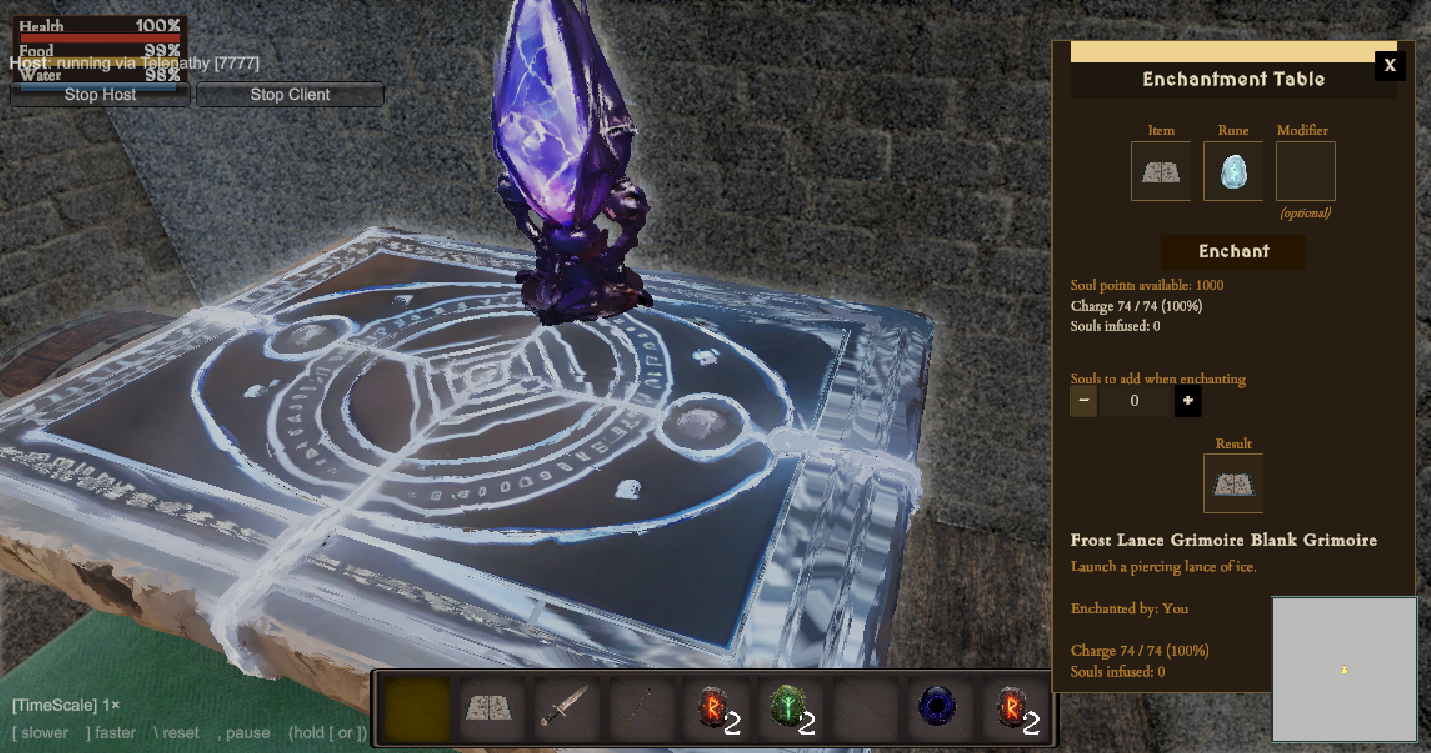
Runes come in element, form, and modifier types, crafted at a runeforge. The enchantment table binds runes to weapons, staves, and grimoires — adding elemental power, twist modifiers, soul points, charge, and heat management. Enchantment and Spellcraft skills gate and improve your results over time.
Combat magic flows through enchanted staves and grimoires in the hotbar, with Elementalism and Warding shaping cast power and defense. Melee is server-validated; bows use draw-and-release aiming with Archery tightening spread as you practice; cannons and traps add siege and base defense options.
Alchemy and brewing
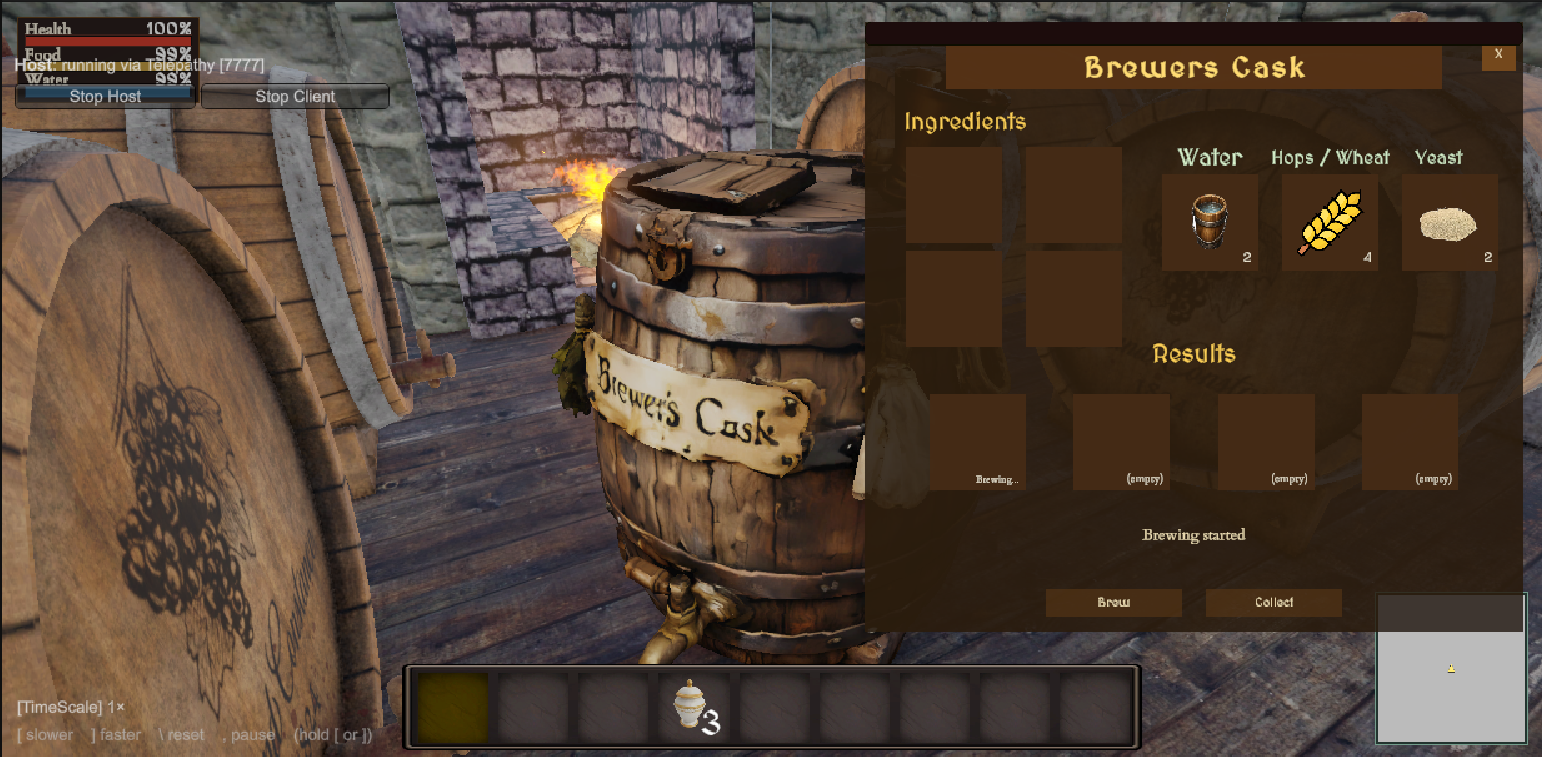
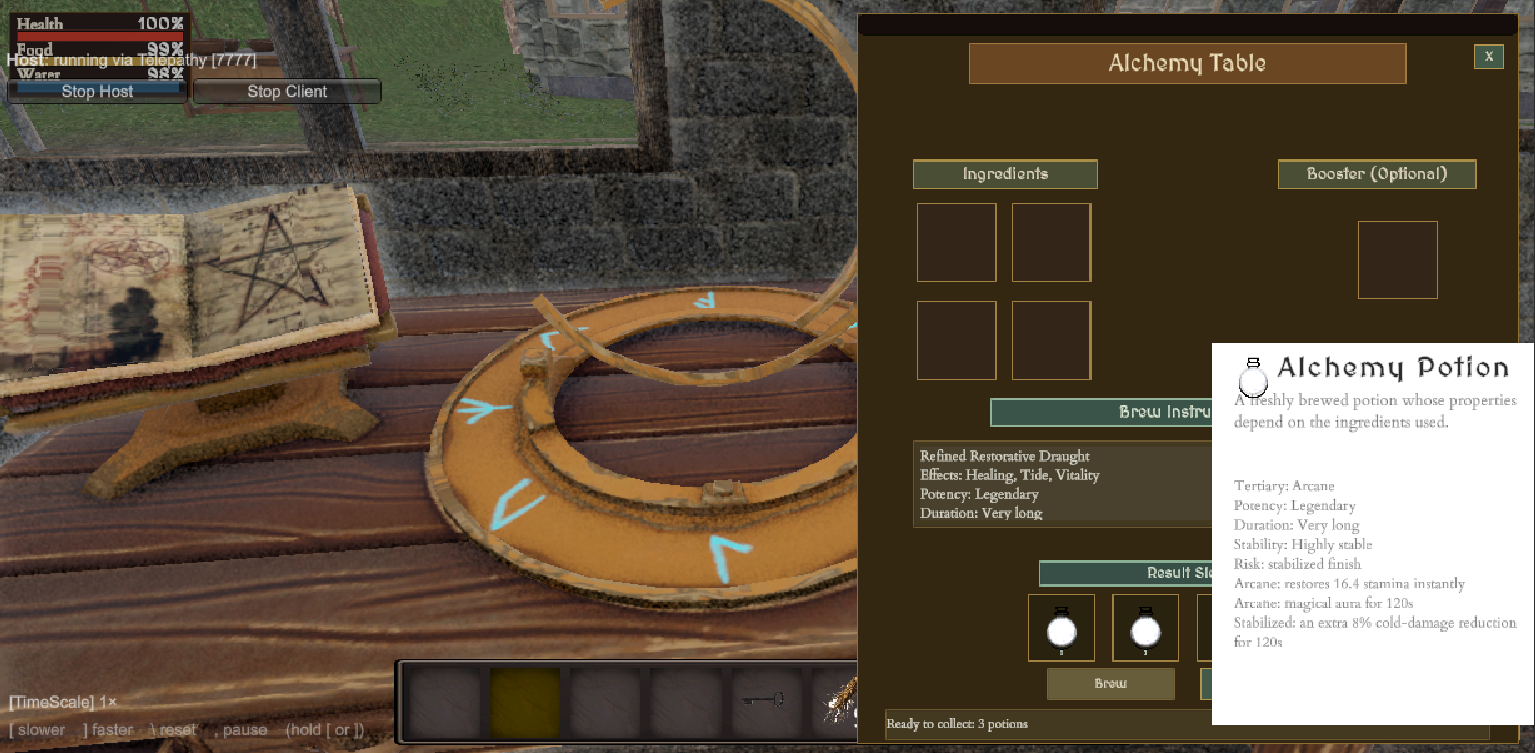
The alchemy station accepts nine ingredients and three boosters per brew — producing potions with networked runtime effects. Your Alchemy skill improves yields and outcomes. Brewers casks ferment beer from yeast, grain, hops, and water, with variables like ABV, toxicity, warmth, stamina effects, and even explosion risk if you push it too far — leveled through Brewing practice.
Summoning
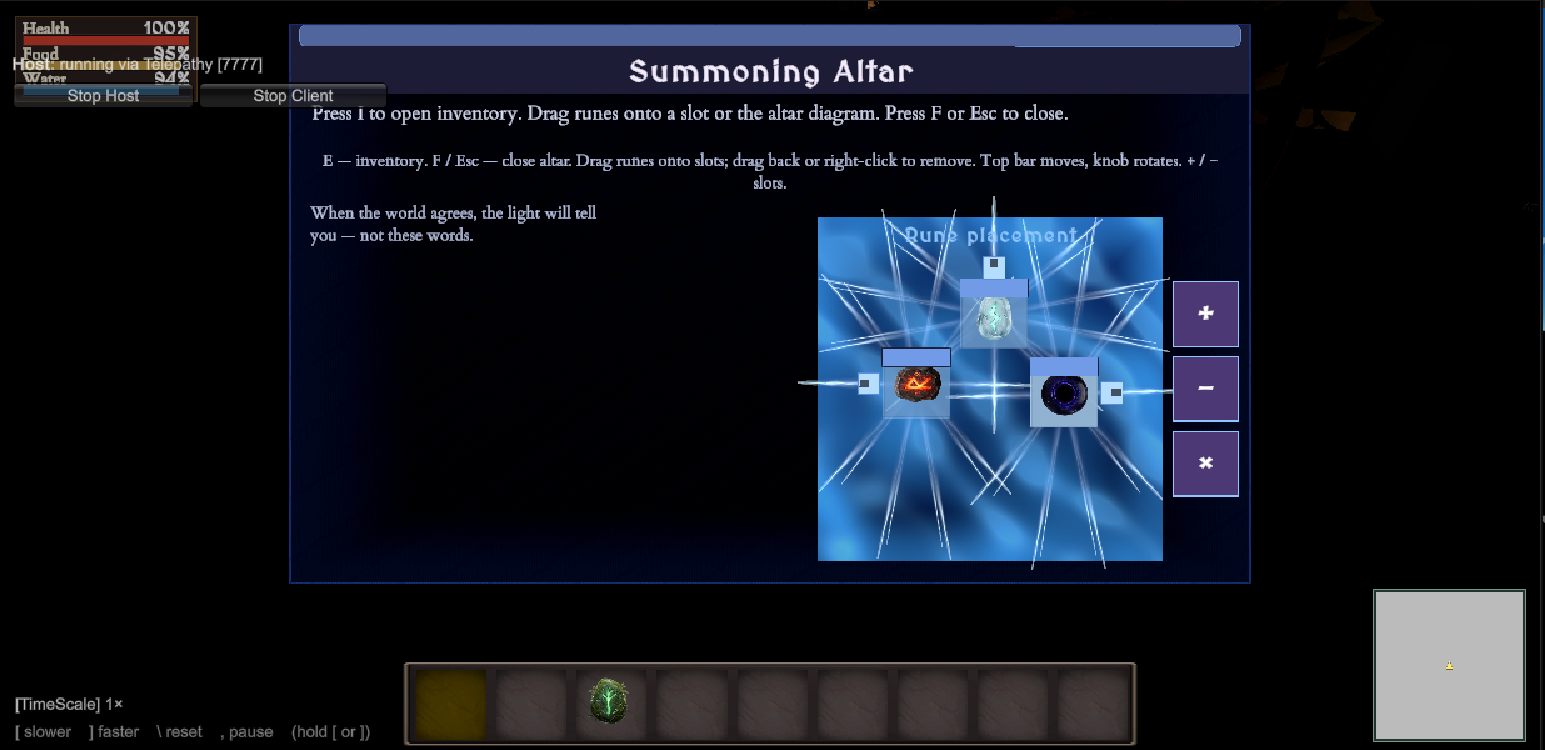
At summoning altars, arrange rune stones into patterns the old builders left behind. Rituals can require specific moon phases, times of day, twilight windows, and weather. Match the pattern and conditions, and something answers — including a fully implemented volcano summon with eruption, lava, molten rock, and downstream alchemical consequences.
Other stations
Spell crafting, arcane forage research, fish bowl aquarium breeding, and a research system for discovering recipes by examining items — each adds another layer to how knowledge spreads across the server.
Building and Territory
Building follows a Rust-inspired grid: foundations, walls, ceilings, stairs, doors, hatches, and windows snap to a structural graph with stability and decay — unsupported pieces crumble over time. Your Building skill improves as you place and maintain structures.
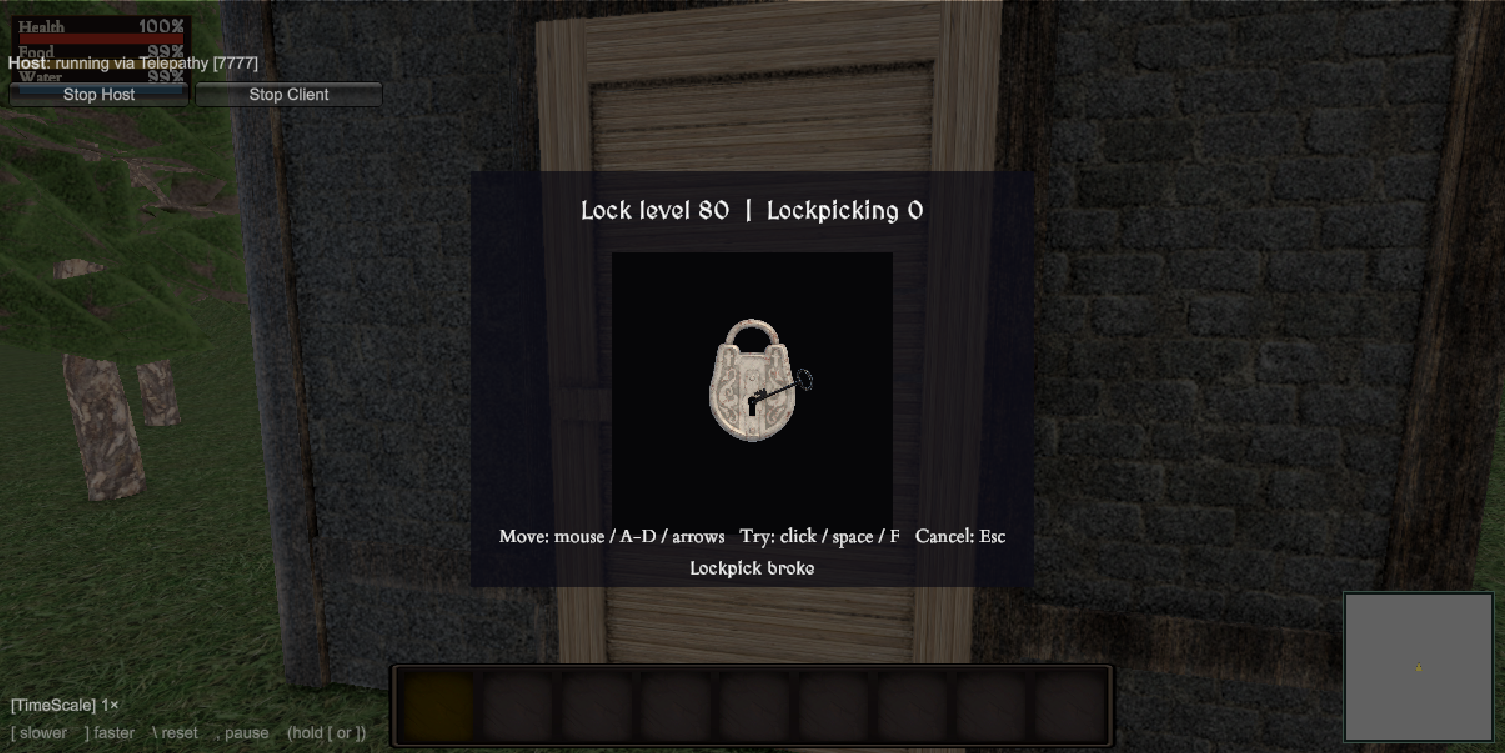
Place objects from blueprints with ground snap and server-side overlap checks. Doors can be locked; lockpicking is a dedicated minigame improved by Lockpicking practice. Warden cores let players claim territory with radius rules, build permits, upkeep, taxes, and decay debt — a framework for player-owned land on a shared server.
Storage structures, fireplaces, cannons, cabins, and pub buildings round out what a settled player can erect.
Creatures and Combat
The wild is populated with bespoke enemies and ambient life.
Hostile creatures include Ice Runebound (adaptive boss-tier AI with charges and shard barrages), Ice Wolves with frost breath, Cave Worms with poison bursts, Hellhounds, Nightlings that thrive in darkness, Trolls, Mammoths, Mushroom Fairies with blessings and spore attacks, Vikra, slimes, balls of light, and more — each with its own locomotion, telegraphs, and loot.
Livestock and ambient life — cows, chickens, cats, crabs, horses, donkeys, and ride bugs — support farming, travel, and atmosphere.
Combat uses element resistances, status effects (poison, chill, fairy blessings), hurtboxes, and server authority. Night is when many threats become truly dangerous — especially if the moon is full and you are not the hunter.
Multiplayer
Manafall runs on Mirror networking with server-authoritative inventory, combat, building, farming, and markets. Up to 100 connections per server. Spatial interest management keeps village NPCs and world simulation tractable at scale. Players can host locally or use relay/hosting infrastructure for dedicated servers.
The design assumes persistent shared worlds: markets restock, crops grow, weather rolls forward, NPCs follow daily routines, skills accumulate through play, and player builds stand until decay or conflict takes them — all while dozens of other survivors pursue the same scarce resources.
Leave a comment
Log in with itch.io to leave a comment.